"OutSystems has been instrumental in accelerating our
digital transformation initiatives."
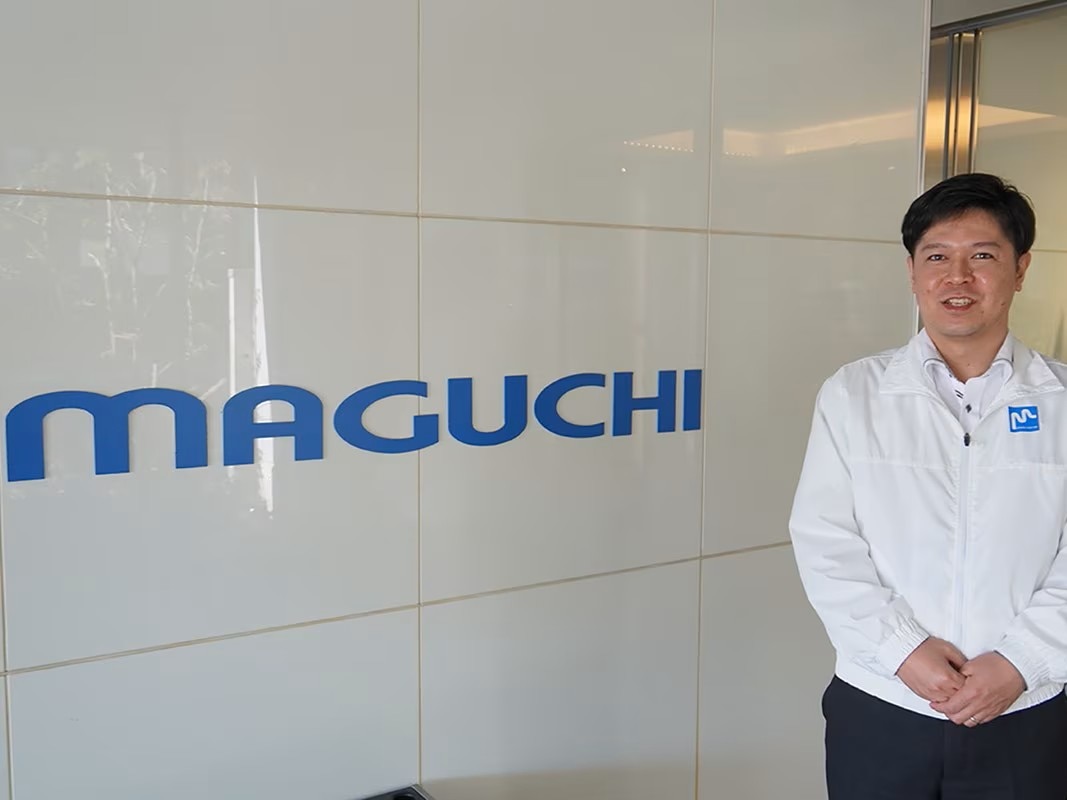
Maguchi Co., Ltd.
Since fiscal year 2018, Maguchi Co., Ltd. has run a highly efficient shared services business by transforming its five core corporate management divisions—Human Resources, Finance, Strategic Corporate General Affairs, ICT, and Procurement—into independent, profit-generating operations across the entire Maguchi Group.
For this case study, we spoke with Mr. Masaki Utsumi (Deputy Manager, ICT Promotion Department), who shared insights into why they selected OutSystems as their standard in-house development environment to fuel their corporate transformation.
ICT Promotion Department
Masaki Utsumi / Deputy Manager
Why We Chose OutSystems
Key Benefits of OutSystems
The Journey to Adopting OutSystems: Embracing Agile In-House Development
Q: What initially sparked your interest in rapid development tools, and what led to the implementation of OutSystems?
Mr. Utsumi: Previously, about 70% of our in-house development relied heavily on Microsoft products like Access, centering around purely manual, scratch-built coding. This traditional approach was highly time-consuming and carried significant risks, such as system bugs—which was a major bottleneck for us.
Furthermore, rather than constantly outsourcing development to external vendors,building internal development capabilities would be crucial for advancing our future IT strategy. We were actively searching for an environment and tools that could streamline application development and allow us to add features via an agile approach, even after systems went live.
With these challenges in mind, we began re-evaluating our development environment about two years ago. Coincidentally, various rapid development tools were starting to emerge in the market at that time. We kicked off our research by attending exhibitions and seminars, as well as reaching out to system vendors in the Kansai region to watch product demonstrations.
Q: How many vendor demos did you evaluate during that research period?
Mr. Utsumi: We evaluated about four different companies. Each had a distinct philosophy and technical focus; two were full development platform environments like OutSystems, while the other two focused on accelerating the upfront design phase.
Between the two development environments, one was strictly specialized in basic web applications. We felt a more versatile platform capable of handling diverse requirements would be ideal, which naturally drew our interest toward OutSystems. Around that exact time, we received a Request for Proposal (RFP) from a client for a web-based service.
Given our engineering capabilities back then, building it from scratch would have taken far too long. That was the turning point when we decided to adopt a prototyping development methodology, and your team introduced us to OutSystems as the perfect match. That was our very first touchpoint.
Q: Did the choice between a Japanese-made versus a foreign-made platform factor into your evaluation?
Mr. Utsumi: Initially, we leaned toward a Japanese product due to potential language barriers and anxieties regarding technical support. Like many others, I had my doubts about foreign software. However, those anxieties were completely wiped away after implementation, thanks to the exceptional and dedicated support provided by your team.

The Ultimate Deciding Factor: A Trusted Partner and the Power of a Global Cloud Platform
Q: Why did you ultimately choose OutSystems despite it being an overseas platform?
Mr. Utsumi: Since it’s a foreign product, there were many unknowns, and back then, few companies around us in Japan had adopted it, meaning resources were scarce. Despite that, the biggest reason we chose it was your team’s extraordinary collaboration and support when we were building our initial prototype in 2018. That was truly the deciding factor.
At the time, we were painstakingly building the prototype ourselves using the free version of OutSystems. Your systems engineers stepped in and offered, "Shall we help you with that?" They took the project back, and before we knew it, they completed the prototype at a breathtaking speed. Frankly, I was astonished that a Tokyo-centered system vendor would go to such lengths for a client based here in Osaka. What’s more, the quality far exceeded a typical prototype—it was so refined we felt we could deploy it immediately.
Setting aside the fact that system upgrade notifications arrive in English, the platform itself supports Japanese, so we haven’t faced any real language barriers. In fact, the benefits of using a globally established platform far outweigh any minor inconveniences. For example, feature requests submitted by users worldwide are constantly integrated into the platform as ready-to-use templates—all accessible at no additional cost.
Whenever our team thinks, "It would be great if we could generate a specific chart here," I feel a sense of camaraderie, knowing that another user somewhere in the world has likely requested the exact same thing. Watching global enterprises succeed with this platform gives us great confidence that we, too, can implement and run proven, world-class workflows.
Q: Aside from our technical support, were there any other critical features that won you over?
Mr. Utsumi: Yes. Among the countless rapid development tools on the market, OutSystems stood out because it allows us to easily build user-friendly applications—including the UI—that directly streamline the operations of our end-user departments.
To ensure user adoption on the frontlines, the UI is absolutely critical. OutSystems allows us to develop applications directly from the screen design phase, which gave us immense peace of mind.
Beyond that, three other core advantages sealed the deal: its infinite scalability for any project size, its ability to manage the entire lifecycle from design to operations in a single stop, and its effortless change management when modifications occur.
Additionally, while many other rapid development tools are on-premise systems that rarely see major updates once installed, OutSystems is a pure cloud-based platform. This means we always have access to the absolute latest version. On-premise solutions don't offer a steady stream of new templates and they come with hefty upgrade fees. The fact that OutSystems continuously evolves day by day is a massive competitive advantage.
Life After Implementation: Delivering Measurable ROI
Q: Did you have any concerns after rolling out OutSystems?
Mr. Utsumi: To be completely frank, because OutSystems is a premium product with a significant annual licensing fee, our biggest concern was whether we could demonstrate a clear return on investment (ROI). To achieve that, we knew our team had to establish a highly consistent pipeline for continuous internal development. Fortunately, seeing how the platform constantly evolves with feature-rich updates gives us immense confidence that we can fully leverage its capabilities for years to come.
Compared to our past tools, the running costs are undeniably higher, which naturally raised expectations across the entire Maguchi Group. Honestly, that created a lot of pressure for my team. However, we are at a critical turning point wherebroad organizational reform and web modernization had become business-critical priorities. I strongly believed it was a challenge worth taking with absolute resolve.
Q: What has been the actual impact of the implementation, and how has the organization reacted?
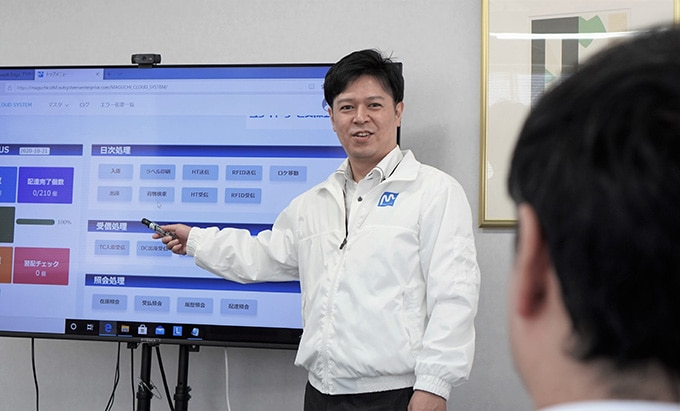
Mr. Utsumi: The platform is already live, and when we demonstrated OutSystems to our President and board members, the feedback was exceptionally positive. Even though we conducted the presentation using a mobile data card, the applications ran flawlessly without a single stutter. Executives highly praised our new ability to unlock and visualize warehouse operations data—something we could never do before—and they have high expectations for our new capability to push real-time updates and notifications dynamically.
In terms of execution, we released two systems using OutSystems in fiscal year 2020, with another scheduled for December 2020, and two more currently in active development.
Driving Group-Wide Digital Transformation
Q: It sounds like your next major frontier is migrating your core legacy systems. Could you tell us more about that?
Mr. Utsumi: Yes. For the past two years, we have been planning a major overhaul of our cross-departmental billing and invoicing management system. I have a strong feeling that OutSystems is the perfect fit for this project. Our strategy is to successfully implement it there first, and then use that momentum to scale out to other areas.
Q: What technology stack is that current billing system running on?
Mr. Utsumi: It’s running on a mix of VB6 (Visual Basic 6.0) and .NET. To be honest, we really should have migrated it during our transition to Windows 7. However, because the system somehow managed to keep running on Windows 10, the urgency faded, making it difficult to justify a complete switch at the time. But internally, frustration among users has been mounting significantly, and the system has reached its practical limits. In that regard, the timing of the timing of our OutSystems adoption has been ideal.
Q: Are there any other major transformations you want to drive forward?
Mr. Utsumi: As part of our group-wide DX strategy, we are focusing heavily on developing systems that seamlessly connect our logistics operations and completely renewing our core IT architecture. To support this, we plan to aggressively strengthen the development capabilities of the ICT Promotion Department. Specifically, we want to expand our pool of specialized OutSystems developers so we can run multiple system development projects simultaneously.
Since we still have many environments where legacy VB6 remains, we realize we can't migrate everything to OutSystems overnight. We will move forward pragmatically, selecting the most appropriate development language tailored to the specific needs of each project.
That being said, OutSystems will undoubtedly be the core engine for our web-based systems, especially those accessed by external users. Our ultimate, long-term goal is to build solutions that benefit not just our own company, but the entire logistics and shared services industry. We have a massive wish list of things we want to achieve (laughs), but we are committed to executing them steadily, year by year.
Expectations for DIGITAL VORN : A Partnership Built on Trust and Commitment
Q: Looking ahead, what are your expectations for DIGITAL VORN's ongoing support?
Mr. Utsumi: When selecting a technology partner, I've always believed that successful partnerships depend on both strong personal relationships and close organizational alignment.
If I were to ask for one thing moving forward, it would be to continue feeding us the latest global tech trends and industry insights as early and as frequently as possible. Building our internal developer capabilities will easily take about a year, so it would be fantastic to have structured knowledge-sharing sessions once or twice a month. To be perfectly blunt, with other system vendors, they are often incredibly enthusiastic before the contract is signed, but then communication abruptly cuts off once the implementation is complete (laughs).
We truly hope you will maintain the exact same support ecosystem you have provided so far. Your company was the first I’ve ever encountered that dedicated two to three full days to intensive training before the official rollout. This level of high-touch, comprehensive support is incredibly reassuring to me personally.
Honestly, we are continually amazed by how completely different you are from traditional system development firms. When we suddenly needed that prototype, most companies would have prioritized rigid specifications, paperwork, and contract alignment. Instead, your team operated with a pure "focus on helping the client in need" mindset. We are deeply grateful for that.
And above all, the execution was incredibly fast. That level of agility is truly impressive. It’s just my personal take, but your approachable and relationship-focused style in the best way possible. It truly feels like you are walking alongside us on this journey.
So please, keep visiting us here in Osaka—even if you’re just lured in by the delicious aroma of Takoyaki! (laughs).
RELATION