How IDOM Reduced Workload by 20,000 Hours Annually
Through Hands-On RPA Training
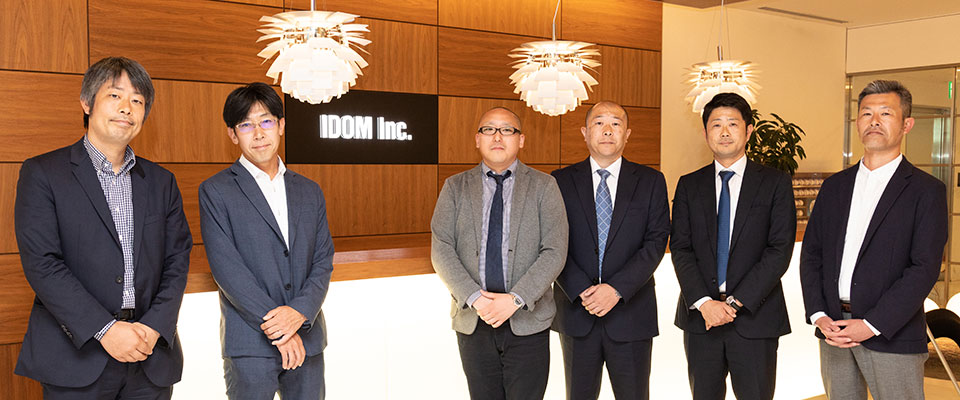

IDOM Inc.
IDOM Inc. is widely known for its used car dealership network, "Gulliver." As the industry leader, tthe company is a market leader in both used car purchasing and sales in Japan. Gulliver International was originally founded in 1994 as the car purchasing division of Tokyo Mycar Hanbai Co., Ltd. In July 2016, the company changed its name to IDOM, reflecting its commitment to "challenging" (idomu in Japanese) the transformation of the automotive distribution industry. In recent years, the company has been expanding its retail store network and currently operates more than 550 directly managed stores across Japan.
The Client's Challenges
Increasing Operational Complexity Driven by Business Growth
Since its founding, IDOM Inc. has developed its business around used car purchasing and wholesaling (used car auctions). Since 2012, leveraging its track record as the "No. 1 in car purchases," the company has expanded its retail store network, currently operating over 550 directly managed stores across Japan. However, as the company entered a transition period in its business model, the biggest challenge became the growing complexity of store operation tasks, which were centralized at their Makuhari office.
"With the business expansion, our acquisitions resulted in a growing number of disconnected systems across the organization. While we initially managed by reshuffling staff, we felt we would soon hit a limit," said Mr. Nagakawa of the Corporate Team.
As a solution, they considered implementing both traditional business systems and RPA (Robotic Process Automation), ultimately choosing RPA. "We concluded that custom system development would not provide sufficient return on investment." Mr. Nagakawa explained.
The Solution
Automating Warranty Claim Processing
During the one-month proof-of-concept (PoC) phase, the first target was the operational tasks involved in handling warranty service applications from stores. The used cars sold at "Gulliver" come with a warranty service in case of breakdowns or defects. Applying for this service generated a massive volume of routine tasks—about 3,000 cases per month—such as entering information into the system. Mr. Yajima, who was in charge of robot development alongside Mr. Tokumitsu, recalls:
"It was a complex operation where the processing steps differed depending on the content of the application. Originally, it was managed by one of our subsidiaries, but since their system was not integrated with ours (the parent company), it required highly complex, hands-on manual work. However, through just a one-month proof of concept (PoC) with BizRobo!, we were able to automate the vast majority of these tasks."

The Results
Expanding Automation Across 23 Business Processes
Including the aforementioned application tasks, the workload reduction during the verification phase was projected to reach 8,000 hours annually. "Based on that reduction effect alone, it was clear that the implementation costs would be the investment would pay for itself," said Mr. Nagakawa.
Following the decision to officially adopt the system, the team spent several months receiving RPA development training DIGITAL VORN, a BizRobo! Gold Partner. These sessions used the company's actual daily operational systems as training material.
"Because we wanted to ensure the success of BizRobo! before our peak business season, we prioritized speed during the first two months, conducting intensive training for 16 hours a week across two days. Over the following four months, our team members developed automation workflows built RPA bots.
We were able to ask Taiyo System Technology questions via email or phone and receive feedback, as well as get advice during our next training sessions. I believe this level of support was the key factor in our successful implementation within such a tight timeframe," Mr. Nagakawa reflected.
In the six months following full-scale implementation, the team built approximately 100 robots, expanding the scope to 23 different operations. "From simple, repetitive tasks to complex workflows requiring human judgment, we successfully streamlined our operations, saving approximately 20,000 labor hours annually," said Mr. Nagakawa.
RELATION